Each year, the Food and Drug Administration (FDA) submits an estimate of medical, scientific, and reserve stock needs for Schedule I and II substances to the Drug Enforcement Administration (DEA). In turn, DEA uses these estimates, along with data from other sources, to set an overall quota or limit for these substances, as well as individual quotas for manufacturers of these substances. In August 2025 the Foundation, in collaboration with the FDA, hosted a hybrid public meeting on "Demand Forecasting for Controlled Substances." This meeting included exploration of the complex factors that are considered when estimating the medical, scientific, and reserve stock needs for Schedule I and II substances, such as opioids and stimulants. Speakers included representatives from government agencies, the private sector, and academic researchers. Click here to read the summary report, watch the meeting recording, and view meeting materials.

Developing clinical practice guidelines (CPGs) for controlled substances requires balancing scientific rigor, clinical practicality, and patient-centered care. In June 2025, the Reagan-Udall Foundation for the FDA, in collaboration with FDA, convened five FDA-funded research teams, federal partners, and guideline developers to explore how to strengthen these efforts—from addressing evidence gaps to improving stakeholder engagement, dissemination, and implementation. The report summarizes key insights on developing clinical practice guidelines involving controlled substances and explores strategies for addressing evidence limitations, engaging stakeholders, and improving communication and implementation.
The Food and Drug Administration (FDA) and the Reagan-Udall Foundation hosted the sixth Online Controlled Substances Summit on September 11, 2025. The Summit explored emerging trends in the online ecosystem, including youth behaviors and platform usage, the human impact of uncontrolled access, and opportunities for intervention and risk reduction. Sessions featured leadership from the FDA, researchers and educators, families who bravely shared first-hand experiences, digital technology companies, and international partners. The sixth event of its kind, the Summit brought the community together to share insights, identify evolving threats and discuss innovative approaches to address this ongoing and complex public health concern.
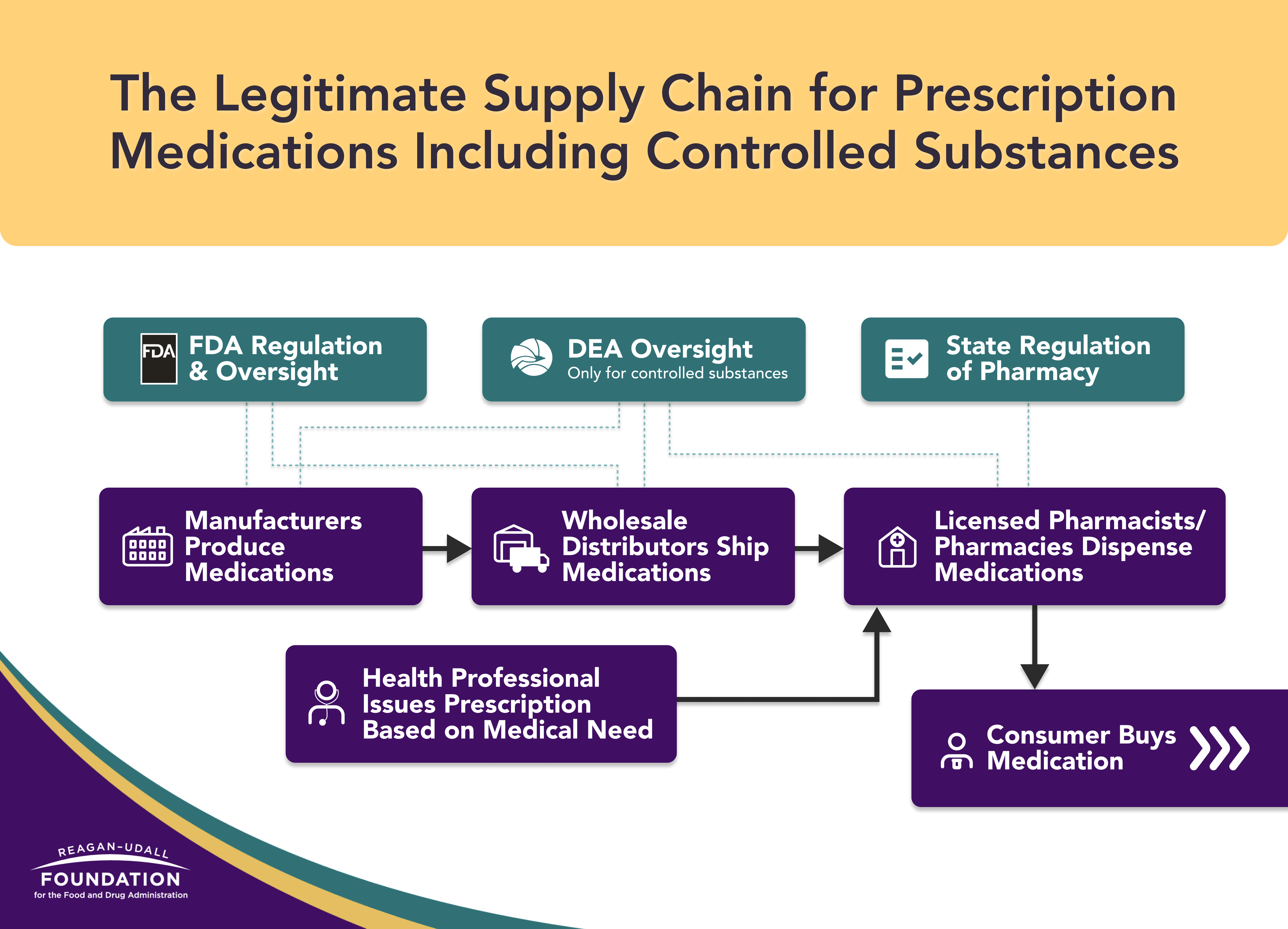
As people turn toward telehealth, accessing care through video calls or app-based services, they are also turning online to access medications. Purchasing controlled substances and other prescription medications online may occur through licensed pharmacies, but also via illegal online pharmacies or non-licensed sellers on websites, social media or apps—often without the consumer even realizing. Differentiating between legitimate and nonlegitimate sources of prescription medications can be tricky. This infographic illustrates the legitimate supply chain for prescription medications.
The Foundation partnered with the Food and Drug Administration (FDA) to host a public meeting on "Mitigating Risks from Human Xylazine Exposure" that explored real-world experiences and scientific evidence on emerging data trends. The meeting also examined concrete strategies for drug development and clinical research that directly support the mitigation and reduction of risks associated with human exposure to xylazine. Presenters and discussants included clinical and scientific experts, community and harm reduction organizations, academic researchers, and federal partners. The Foundation produced a report from the meeting that outlines actions needed to address xylazine exposure and the larger overdose crisis.
In June 2023, FDA issued its first psychedelics draft guidance for industry, Psychedelic Drugs: Considerations for Clinical Investigations, to provide general considerations to sponsors developing psychedelic drugs for treatment of medical conditions. While the guidance highlights some considerations for designing clinical trials with psychedelics to optimize the interpretability of results, many questions remain about the most appropriate way to address these challenges. The FDA Foundation convened “Advancing Psychedelic Clinical Study Design,” a public meeting to discuss the experience of scientists working with psychedelics in FDA-authorized clinical studies and drug development, considerations for psychedelics in clinical trial designs, and perspectives and current research in psychedelic clinical trials. The meeting also provided an overview of Psychedelic Drugs: Considerations for Clinical Investigations.
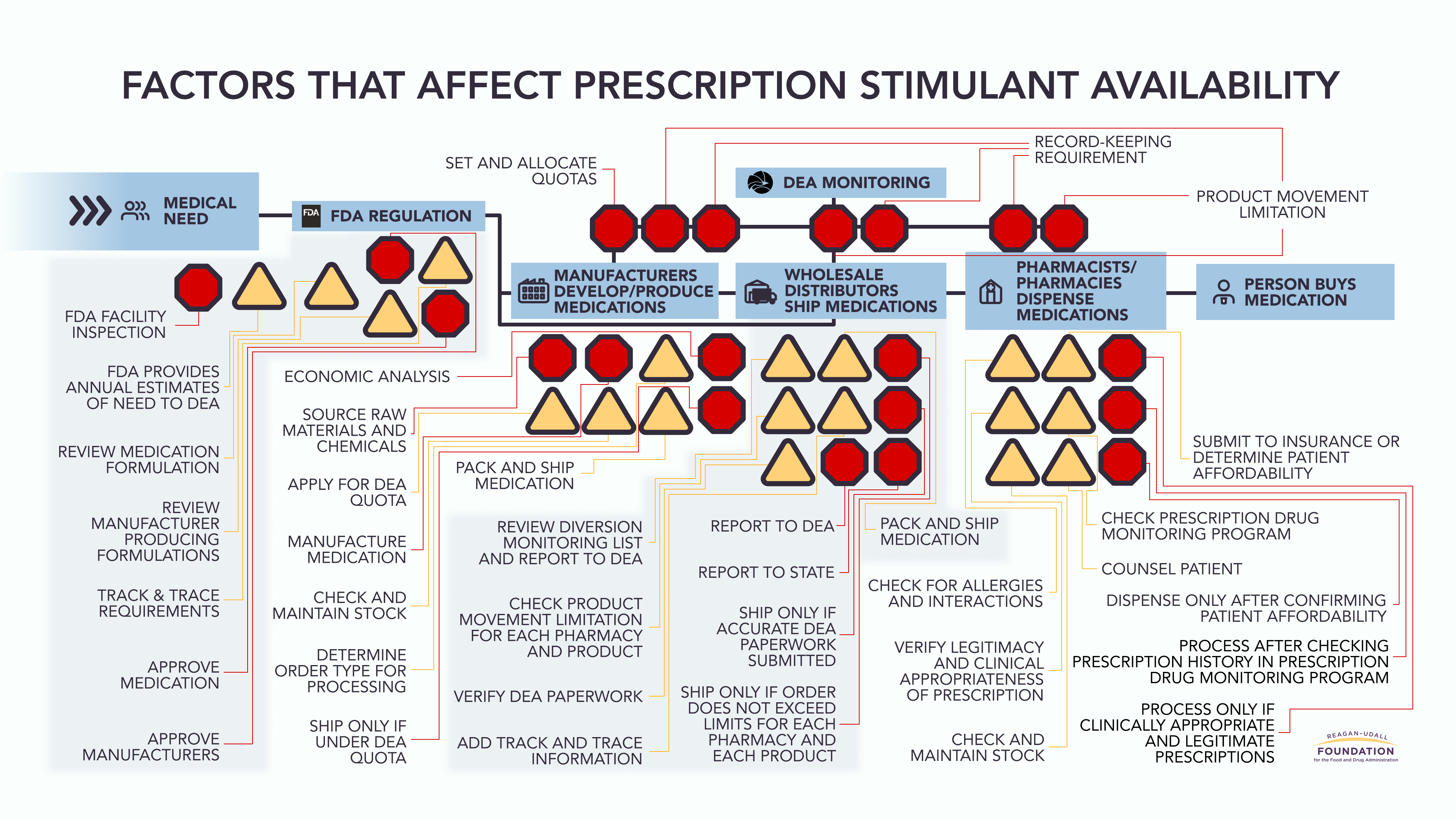
In recent months, families and individuals have reported increased challenges in accessing prescribed stimulant medications such as those used to treat Attention-Deficit/Hyperactivity Disorder (ADHD). The Foundation, in partnership with the FDA, has embarked on a new project to illustrate the factors that affect prescription stimulant availability.
The pathway to access these medications, classified as controlled substances, may seem straightforward with a relatively simple supply chain. In reality, the path of a prescription stimulant—from approval through manufacturing, distribution, and dispensing to the patient—has a number of challenging steps and requirements, any of which may slow down or interrupt the movement and accessibility of the medication. This preliminary image presents an illustrative but not exhaustive view of that complexity.